

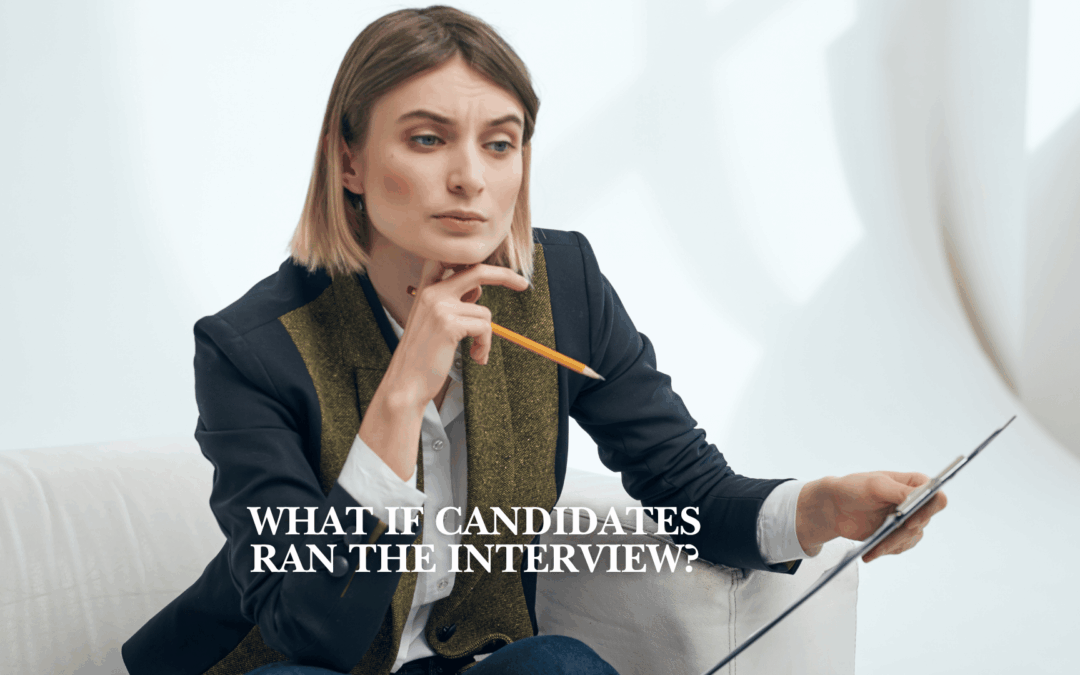
Picture a hiring process where the candidate holds the clipboard.
They set the questions. They decide who advances. They choose whether you are worth their time, their talent, and the years of their life they are about to hand over. You, the employer, are the one selling. You are the one hoping for the callback.
It sounds backward. It is closer to the truth than most leaders realize. Every strong candidate is already interviewing you. They are just polite enough not to say so out loud. This thought experiment does not invent anything new. It only removes the polite silence and lets us see what top talent has been quietly evaluating all along.
So let’s run it all the way out.
The questions would flip
Today a candidate walks in braced for “Tell me about a time you failed.”
Hand them the clipboard, and the employer hears, “Tell me about a time your leadership failed someone on your team. What did you do about it?”
“Walk me through the last person who quit. Why did they really leave?”
“When my work is exceptional, how will I know? When it misses, how will you tell me?”
“What does this role actually change for the company, the customer, or the person next to me?”
“Show me the pay range now, not after three rounds.”
Notice what those questions have in common. None of them are about tasks and duties. They are about purpose, leadership, clear outcomes, fair pay, and whether the culture holds up when no one is watching. Those are the same things that make people stay. Candidates already know this instinctively. The clipboard just gives them permission to ask.
What employers would change to win
Here is the part I find genuinely exciting. To win a candidate who is doing the choosing, a leader would not need a gimmick or a bigger sign-on bonus. They would need to get honest and get clear.
They would state their purpose out loud, because a candidate who believes in the work will out-perform and out-last one who is only there for a paycheck.
They would prove their leadership rather than describe it. When the candidate is in charge, “we have a great culture” does not survive contact. The candidate calls your current employees and your former ones. Your reputation, not your careers page, does the talking.
They would put expectations and outcomes on the table early. Most people who leave inside the first year do not leave over the duties. They leave because no one drew a clear picture of what winning looked like, so they never felt like they were winning.
They would name the pay range without being cornered into it. Money is not what pulls a great person in, but hiding it is a fast way to lose their trust.
And this is the one closest to my heart. They would stop masking their weaknesses. A leader confident enough to say “here is what we are still bad at, and here is the gap I need you to fill” is a leader worth following. That honesty is not a liability. It is the whole point. The synergy shows up exactly where an employer is willing to admit what they cannot do alone.
None of that requires a leader to be perfect. It requires a leader to be a learner. Most were simply never taught to see hiring as a two-way sale. Once they see it, they can act on it.
Why this would be good for all of us
This is not a small internal tweak. It reaches the family dinner table and the community.
Only 20% of employees worldwide were engaged in their work in 2025, the lowest level since 2020, according to Gallup’s State of the Global Workplace report. That disengagement carried an estimated price tag of more than $10 trillion in lost productivity, roughly 9% of global GDP (Gallup, April 2026). And about 70% of the difference in team engagement traces back to one person, the leader.
Read that last number again, because it is the good news hiding inside a hard statistic. The biggest lever on engagement is not a perk, a policy, or a ping-pong table. It is leadership. Leaders hold more power to fix this than anyone else in the building.
When candidates get to choose well, fewer people land in work that drains them. More people go home tired from the work day but energized by the work itself, and excited to come to work tomorrow. That is the difference I care about. That kind of energy does not stay at the office. It shows up as patience with a spouse, presence with a kid, and generosity with a neighbor. Good job fit is not just a business outcome. It is a family and community outcome.
I have watched it play out too many times to think otherwise.
What candidates are not ready for
Hand most candidates the clipboard today and they would not know what to do with it. We have trained an entire workforce to sell themselves instead of evaluate. People show up ready to impress and completely unready to assess.
Here is what trips them up.
They do not know themselves. You cannot judge whether a job fits you if you have never defined how you think, how you behave, and what you are genuinely passionate about. Most people are guessing.
They mistake being liked for being a fit. A warm conversation with a charming leader feels like a green light. It is not. Chemistry is not compatibility.
They do not know the right questions. Left to instinct, candidates ask about vacation days and dress code and skip right past leadership, clarity of expectations, and whether the culture has integrity when it is inconvenient.
They cannot always read the room. Sensing a values gap or a leadership red flag takes emotional intelligence that most people were never coached to build.
And plenty of people simply cannot afford to walk away, which is real and worth naming plainly. Leverage is not evenly distributed. That does not make the skill of choosing less important. It makes it more important, so that when the chance to choose does come, a candidate is ready to use it well.
How candidates get ready
The preparation is not complicated, but it does take intention.
Start with self-awareness. Get clear on how you think, how you show up, and what actually lights you up, ideally with a real, designed for hiring, assessment rather than a gut feel or personality assessment. This is the foundation. Everything else is guesswork without it.
Define your fit before you sit down. Write your non-negotiables. Name the kind of leadership you need, the kind of work that pulls the best out of you, and the pay that is fair for your market. Decide what you are looking for before someone tells you what to want. (If you’d like a guide for this work check out our Partner, Sarah JanTausch.)
Learn the questions that matter. Ask about purpose (do you want to fight for the things they’re fighting for?), about how the company handles failure, about what success looks like in the first ninety days, and about why the last person in this seat left. Listen for whether the answers are specific or rehearsed.
Do your own reference check. Talk to current and former employees. The clipboard is most powerful when you use it on the people the employer did not hand-pick for you.
Pay attention to what a leader does under a hard question, not just what they say. Integrity leaks out in the moments no one scripted.
The bottom line
We do not actually need to hand candidates the clipboard for this to matter. The best of them are already grading you, whether you acknowledge it or not. The employers who win are the ones who behave as if the clipboard already changed hands, who lead and hire as though they have to earn the yes.
Stop trying to force round pegs into square holes. Start telling the truth about who you are, what you need, and where your gaps are. Do that on both sides of the table, and you get the thing I will keep fighting for: people in work that fits them, leaders and employees each becoming the best version of themselves, and the ripple that follows into every home and neighborhood they touch.
That is a workplace worth building. It starts the moment both sides stop pretending and start choosing on purpose.